The Bureau of Economic Geology’s new RAMS research consortium combines the work of the Mudrock Systems Research Laboratory (MSRL) and Tight Oil Resource Assessment (TORA) consortia. This effort addresses key research questions about unconventional oil and gas reservoirs by integrating geologic core-based characterizations, lab-based and fundamental measurements, sedimentology, depositional systems, rock facies models to improve calibrations of petrophysics models as input to static reservoir models. These efforts inform basin-scale static models and finer sector-scale static/dynamic models, resource estimates, productivity analysis, and economic models. This research plan continues efforts to understand parameters that control rock geomechanics; mechanical stratigraphy; oil, gas, and water saturations effective permeabilities; fluid flow dynamics; and production in mudrock systems. RAMS will focus on methods to leverage core-based observations to inform reservoir models and use detailed pore-scale analyses to inform questions and uncertainties from regional-scale observations.
Areas of Interest
The RAMS research plan is updated annually based on input from member companies. Current reservoirs of study include the Woodford and Barnett Shales; the Wolfcamp, Bone Spring, Spraberry, and Avalon Formations within the Permian Basin; and the Eagle Ford Group, Austin Chalk, and the Haynesville and Bossier Shales in East Texas and Louisiana. Our multidisciplinary approach-based reservoir models help better understand rock and fluid attributes that are important to unconventional reservoirs.
Datasets and analytical capabilities
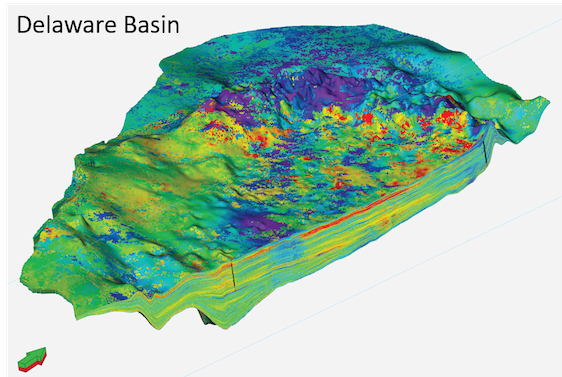
RAMS has access to data from over 200 characterized cored intervals, stratigraphic models from formation tops picked on over 20,000 wells, seismic datasets that include the Delaware and Midland Basins, and high quality petrophysics on over 1,800 wells in the Permian Basin. RAMS maintains laboratory capabilities for core characterization, pore network description and quantification, porosity, permeability, wettability, relative permeability, TOC and thermal maturity assessment, source potential evaluation, and organic and inorganic geochemistry.
Key Research Thrusts
Geologic characterization
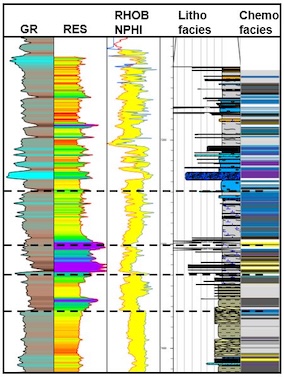
RAMS informs knowledge of depositional systems using high-resolution core characterizations that include lithofacies descriptions, high-resolution X-ray fluorescence (XRF) core scanning, X-ray diffraction (XRD) mineralogy, quanitative petrography via light and scanning electron TOC, HAWK pyrolysis, microscopy (SEM), and static pore network characterizations that are integrated with wireline logs to calibrate petrophysical models and predict fluid saturations, mineralogy, porosity, pore pressure, and rock mechanics.
Static and dynamic reservoir model/characterization
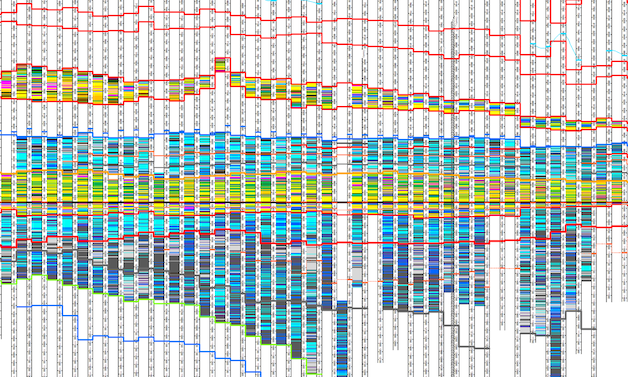
Regional stratigraphic frameworks informed by sedimentology, depositional models, geologic core characterizations, petrophysical models, and seismic datasets are used to construct basin-scale static models and finer sector-scale static/dynamic models, which are also used to calculate resource volumes, drilling hazards, and less-productive intervals.
Engineering
Fluid flow and phase behavior modeling helps estimate resources and recoverable volumes. Decline curve analysis feeds into future production potential projections and production uplift estimates from enhanced oil recovery. At sector-scales, an integrative workflow models hydraulic fracture propagation, reservoir production numerical simulation, and production-induced stress redistribution to evaluate completion parameters in terms of their impacts on reservoir performance.
Cored-based pore network and fluid flow analysis in nanoporus rocks
Multiscale imaging (pore to core) and innovative laboratory measurements, ML-based image segmen-tation, pore classification, and simulations determine wettability, relative permeability (gas-liquid or liquid-liquid) in mudrock systems to investigate dynamics of fluid displacement, fluid phase distribution, and the underlying geologic controls.
Produced fluid geochemistry
Time-series produced oil composition and biomarker fingerprinting are critical for understanding drainage volume and identifying fluid contribution changes during production. Produced oil hydrocarbon composition and biomarker fingerprinting also provide robust evidence for assessing oil maturity and quality.
Effect of clay mineralogy on unconventional reservoir properties
Clay mineralogy and occurrence play an important role on rock mechanics, well completion strategies, petrophysical properties, fluid flow transport, sediment depositional systems, and diagenesis. SEM and quantitative XRD describe and quantify the role of clay mineralogy and occurrence on reservoir quality and oil and gas deliverability.
Economics
Technological and cost improvements, commodity prices, basis differentials (logistics), pace of drilling, well attrition, and lease accessibility predict production outcomes to assess block profitability for potential well locations.
Membership and benefits
RAMS membership is $75,000 annually, with contributions leveraged by State of Texas support and other sponsor funding. Benefits include:
- Spring annual meeting: Technical presentations, a core workshop, and networking
- Winter short course and core workshop: Two-day event focused on mudrock systems
- Fall field trip: Outcrop studies from formations of interest coupled to a core workshop
- RAMS webinars: RAMS researchers host webinars to highlight new research
- Data access: All consortium reports, presentations, posters, extended abstracts, short course materials, presentation videos, and published papers, including legacy MSRL and TORA data and reports
- Informational resource access: Basic-scale static models, formation tops, structure, geologic maps (GIS-format), and well log facies-predictions
- Hands-on involvement: Access to RAMS researchers, and opportunities for individualized, sponsor- focused core workshops and short courses
- Done-for-you characterization and integrations of donated/loaned cores

